A visit ticket to the Paris Opera House does not open a building; it opens a sequence. Charles Garnier designed the rooms to happen in an order, and walking them out of order is possible but pointless. Here is each one, what is in it, and how long it is worth. Paris Opera House guided tours cover every room below.
How the time actually breaks down
| Room | Give it | What it is |
|---|---|---|
| La Rotonde des Abonnés | 4 minutes | The subscribers' rotunda, where the carriages set down |
| The Pythia basin | 2 minutes | A bronze oracle coiled with snakes at the foot of the ramp |
| The Grand Staircase | 20 minutes | White marble under a thirty-metre well |
| The avant-foyer | 5 minutes | Gold mosaic, deliberately low |
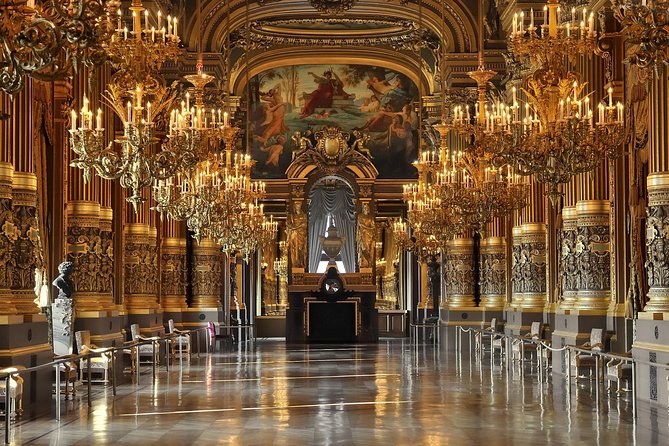
| The Grand Foyer | 25 minutes | Fifty-four metres, gilded, with Baudry's ceiling |
| The Sun and Moon salons | 8 minutes | A matched pair, gold and silver |
| La Rotonde du Glacier | 6 minutes | Tapestries, and the best morning light |
| The Library-Museum | 15 minutes | 600,000 items, and hardly anybody in it |
Start at the bottom, in the dark
The Rotonde des Abonnés is the only room in the building designed to feel like a basement, and that is on purpose. Subscribers drove in under the building and stepped out here, out of the weather and out of sight. It is low, cool and dark in marble, and everything after it is a release from it.
The Pythia is the bronze at the centre: the oracle of Delphi, coiled with snakes, above her basin. Most people take three steps past her. Give her a minute.
The Grand Staircase, and why it splits
Twenty minutes, and most visitors give it more. The stair rises into a well of open air thirty metres high, splits into two curving flights and rejoins. Structurally that is an awkward way to reach the first floor. Socially it is the whole point: nineteenth- century Paris came here to be seen, and the arrival was the first act.
Stand on the first landing and look back down. The lamps light faces rather than floors, and everybody below is arranged in a shallow bowl. The rooms page has the rest of the detail.
The avant-foyer, which is short on purpose
Five minutes, and you will want to leave sooner, which is the intention. It is low and vaulted in gold mosaic, close enough overhead to read without straining. Compression before release: the Grand Foyer through the doors is the release.
The Grand Foyer, at fifty-four metres
Twenty-five minutes, and the longest single stop on the ticket. Fifty-four metres long, thirteen wide, eighteen high, mirrors down one side and windows down the other so the light doubles. Paul Baudry's ceiling panels run the history of music from end to end.
Walk it once looking up and once looking along. They are two different rooms. It was built for the interval, which is to say for walking slowly in evening dress, and it still rewards being taken at that speed.
The Sun and Moon salons, which people miss
Eight minutes for the pair. They sit at either end of the foyer and the foyer pulls your eye straight through the middle, which is why most visitors never turn. The Salon du Soleil is gold and mosaic and reads as morning; the Salon de la Lune is silver and mirror and reads as one in the morning.
La Rotonde du Glacier, and the best light in the building
Six minutes. The ice-cream rotunda, and it was exactly that. Tapestries on the walls, painted panels of drinking and hunting overhead, and the least formal room in the sequence. On a bright morning it is also the best-lit room here, which matters if you are photographing.
The Library-Museum, which almost nobody enters
Fifteen minutes, and it is included. The Bibliothèque-Musée de l'Opéra sits in the Emperor's pavilion, run by the Bibliothèque nationale de France, holding close to 600,000 items and a rotating exhibition. It is a door off the route rather than a room on it, which is the only reason it is quiet. The exhibitions page has what is showing.
The ninth room, which you may not get
Which direction to walk it in
There is only one, and the building enforces it. You cannot start at the Grand Foyer and work backwards, because the route is a one-way sequence up from the rotunda and out past the library. What you can do is slow down or speed up, and the mistake almost everybody makes is spending too long at the bottom of the staircase, where the view is worse, and not enough at the top of the first flight, where it is best.
The other thing worth knowing is that the auditorium door, if it is open at all, comes late. Do not spend your whole allowance before you reach it.
What is not in the building you are shown
- The stage and the wings. It takes up to 450 performers and no visitors.
- Dressing rooms and workshops. Not on any captured departure.
- The Foyer de la Danse. Closed. The Opera's tablet at €8 on site, €7 booked ahead layers it over the room you are standing in, which is as close as anyone gets.
Before you go in: the front you will not enter by
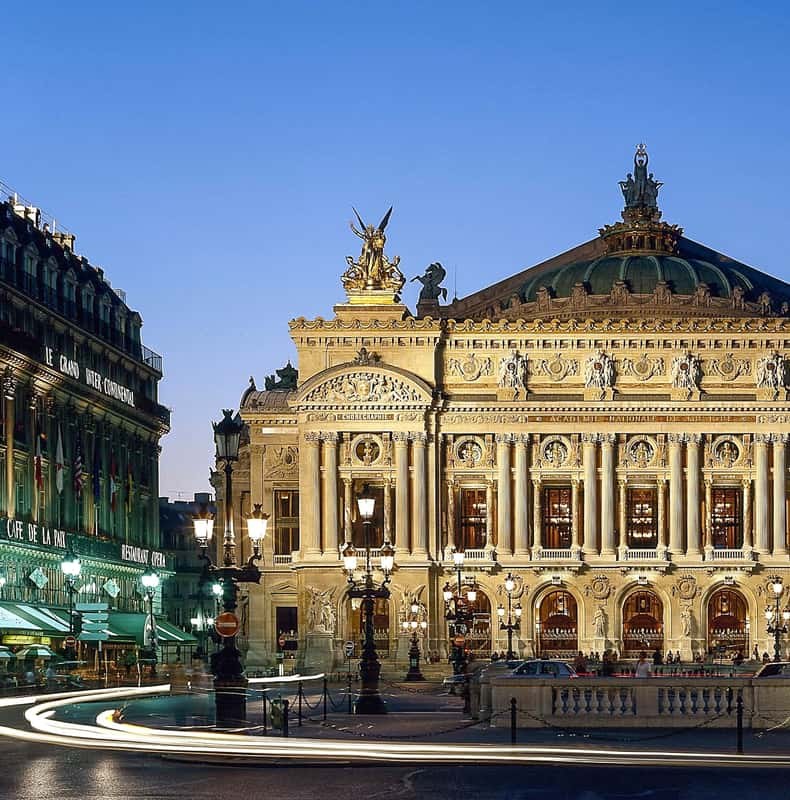
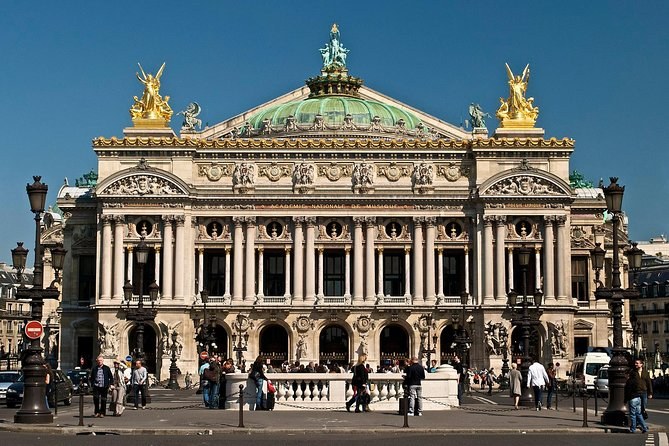
Give the facade five minutes from across the square, because you are about to spend ninety minutes not being able to see it. Seven arched bays at street level, a colonnade above them, gilded bronze groups at the roofline and the flattened green dome of the auditorium behind. The lettering across the front reads Académie Nationale de Musique, which is what the company was called when the building went up.
Then walk right, along the flank, because the visitors' door is on the corner of Rue Scribe and Rue Auber and the steps you have been photographing are shut.
Photographing each room
Four practical notes, in walking order. The Rotonde des Abonnés is dark and needs a steady hand rather than a flash. The Grand Staircase is lit from a well thirty metres overhead, so anybody standing at the top is a silhouette and anybody on the first landing is not. The Grand Foyer takes its light from windows down one side, which means afternoon rather than morning if you want the length of it lit.
And the Rotonde du Glacier is the best-lit room in the building on a bright morning, which almost nobody notices because it comes at the end. The gallery has the rooms as they actually photograph.
Doing it in less than eighty-five minutes
If you have an hour, cut the Library-Museum and the salons and give the staircase and the foyer what they are worth. If you have two, add the exhibition and slow down. The itinerary guide sets out both versions minute by minute, and the visiting post covers the tickets and the door.
Want somebody naming these rooms as you walk them? Paris Opera House Tours lists the guided departures with what each fare covers and how long it spends inside.