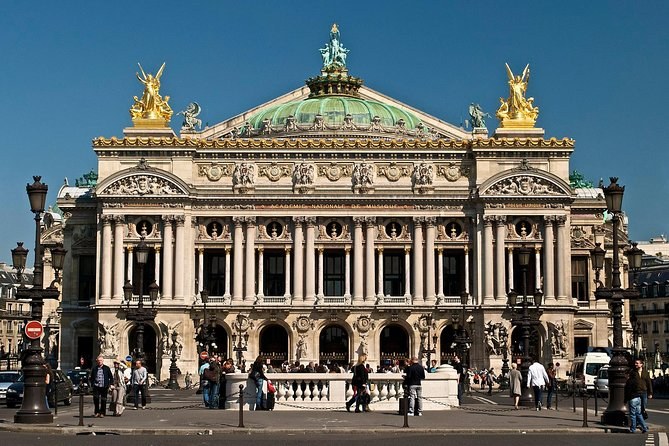
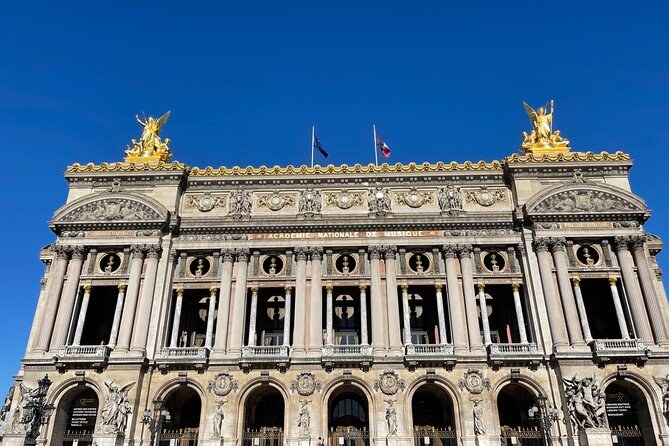
This building has been collecting stories for 150 years, and about half of what you will hear repeated about it is Gaston Leroux rather than history. These fourteen are the ones that survive checking, and a guide will tell you most of them while you are standing in the room they happened in.
The four dates worth carrying
| Date | What happened | Why you will hear about it |
|---|---|---|
| 14 January 1858 | Orsini's bomb outside the old opera house | It is the reason this building exists at all |
| 5 January 1875 | The Palais Garnier opens | Fifteen years and one war later |
| 20 May 1896 | A chandelier counterweight falls through the ceiling | One death, and the scene Leroux borrowed |
| 1964 | Chagall's ceiling goes up over the original | Both ceilings are still there |
1. It exists because of an assassination attempt
On 14 January 1858, Felice Orsini's bombs went off outside the old opera house on the rue Le Peletier as Napoleon III arrived. The Emperor was unhurt. The lesson he took was architectural: a head of state needed an opera house he could enter privately, and Paris got one. The history page has the sequence.
2. The architect was thirty-five and nobody had heard of him
171 projects were entered. Charles Garnier was 35, had won the Prix de Rome and had built almost nothing, and the jury chose him unanimously in the second round. He then spent fifteen years on the building, and it took his name instead of the Emperor's.
3. Asked what style it was, he said it was Napoleon III's
The Empress is said to have complained that it was neither Greek nor Roman nor Louis anything. The reply has been quoted ever since, and it is the most honest thing anybody has said about the building's style.
4. There is a water tank under it, and it is still full
Digging the foundations hit groundwater that eight steam pumps could not remove in five months. Garnier gave up removing it and built a double foundation with a sealed concrete tank between the layers, 10.13 metres below ground. It is still there, still full, and the Paris fire brigade uses it for diving practice.
5. It is not a lake with a boat on it
Leroux's novel put a phantom, a lake and a boat down there. What is down there is a rectangular tank designed to stabilise a building and hold water for a fire. Both facts are more interesting than either story on its own.
6. A chandelier counterweight killed somebody in 1896
7. Chagall painted over a ceiling that is still there
André Malraux commissioned Marc Chagall to paint a new auditorium ceiling in 1964. It went up on a frame above the nineteenth-century one rather than in place of it. Both exist, one hidden behind the other, and the argument about whether it should have happened is still running.
8. Two capacity figures are both correct
The Opera publishes a capacity of 2,101. The seat count is 1,979. Every source picks one and is half right; the difference is boxes and standing. The facts page prints the pair.
9. The Emperor's private entrance was never used
The west pavilion was built with a ramp so that Napoleon III could drive in under guard, which was the whole reason for the project. The Second Empire fell in 1870 and the building opened in 1875. He never saw it. The pavilion holds the library and museum now.
10. It was finished because a rival burned down
Work had stalled through the war and the Commune, and the Third Republic was in no hurry. Then in 1873 the old opera house on the rue Le Peletier burned down, and Paris had a national opera company with nowhere to perform. The half-built palace on the boulevard became urgent overnight.
11. It opened on 5 January 1875, unfinished
The inauguration went ahead a year early with the Emperor's pavilion, a gallery and the Salon du Glacier still incomplete. The total came to just over thirty-five million gold francs.
12. The stage takes 450 people
It is the largest in Europe and holds up to 450 performers. Almost no visitor ever sees it, because it sits behind the one door a visit ticket does not open. The rooms page lists what is and is not on the ticket.
13. Nearly half a million people visit each year
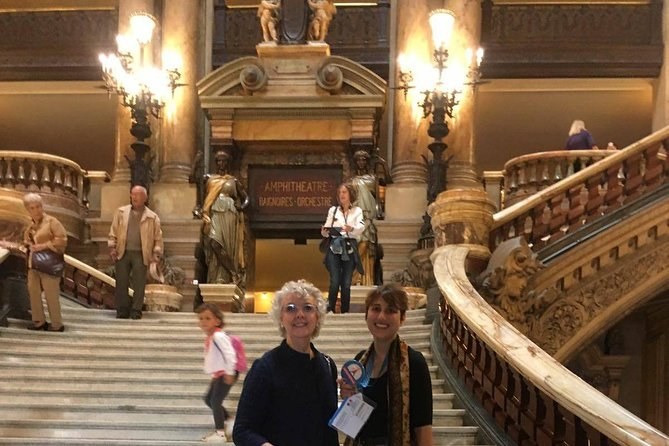
Around 480,000 a year, which is a lot of feet on a marble staircase and exactly why the travellers who describe the rooms as uncomfortable are all describing the middle of the day.
14. It has been a listed monument since 16 October 1923
Listed as a monument historique, and still a working theatre with a company rehearsing in it, which is the reason a room can be shut on the morning you arrive. The company page explains the arrangement.
What the reviews get right, and what they repeat
Three of these facts turn up in traveller reviews unprompted: the tank, the counterweight and the hidden ceiling. That is a fair sign of what guides actually tell people, and it is a good test of whether a departure is doing its job. If a guide gets through ninety minutes without mentioning any of them, you have had a tour of a beautiful room rather than a tour of a building.
What the reviews also repeat, and what is not true, is the lake with a boat on it. One traveller here writes that Phantom fans will get what they came for, which is fair enough, and then adds that the building tells its own story without it. That is the more useful sentence.
Two numbers that get repeated wrongly
The first is the chandelier. It weighs seven tonnes and cost thirty thousand gold francs in 1875, and it did not fall in 1896 — a counterweight did, which is a different and smaller object taking a different and shorter path. The chandelier is still up there.
The second is the seat count. 1,979 is the number of seats and 2,101 is what the Opera says the room holds, and neither figure is wrong. Sources that print one and call the other a mistake are the reason this keeps coming up.
The one that is neither fact nor fiction
Box five. The Opera plays along with it, the novel invented it, and there is no historical phantom to have sat in it. But the building did keep a subscribers' box system, the boxes were held by names rather than by tickets, and the social machinery Leroux was satirising was entirely real. What is fiction is the tenant, not the arrangement.
The history page covers the 1896 accident and the water tank in their proper order, both of which Leroux borrowed.
Which of these you will actually be told
If you take a guided departure you will hear the tank, the counterweight and the hidden ceiling, because those three are what guides here reach for. You are unlikely to be told the two capacity figures, and you will almost certainly be told something about the Phantom that is not true, which is fine as long as you know which half is which.
If you go in on the ticket alone, you get none of it unless you rent the Opera's tablet, which is why the travellers who took the ticket without it say what they say.
What to do with all this
- The tank, the counterweight and the hidden ceiling are the three that get told on almost every guided departure.
- The two capacity figures are the one nobody tells, which is why the facts page prints both.
- Box five and the underground lake are Leroux. Enjoy them as fiction.
Hear these on site instead of reading them: Paris Opera House Tours lists the guided departures, and the history page puts the dates in order.