Ninety minutes is the number both the self-guided ticket and the shortest guided departure work to, and it is not arbitrary. The building is a one-way sequence and the rooms have natural lengths. Paris Opera Garnier tours all work to the same clock, so this plan applies whichever you book.
How long does each room take?
| Room | Give it | Running total | What you are looking at |
|---|---|---|---|
| La Rotonde des Abonnés | 4 min | 0:04 | the subscribers' rotunda under the staircase, where the carriages once set down |
| The Pythia basin | 2 min | 0:06 | the bronze Pythia coiled with snakes at the foot of the ramp |
| The Grand Staircase | 20 min | 0:26 | white marble, a 30 metres-high well, and two flights that split so the room can watch itself arrive |
| The avant-foyer | 5 min | 0:31 | the low mosaic-vaulted room you cross before the doors open |
| The Grand Foyer | 25 min | 0:56 | 54 metres long, 13 metres wide and 18 metres high, gilded end to end |
| The Sun and Moon salons | 8 min | 1:04 | the two round rooms at either end of the foyer |
| La Rotonde du Glacier | 6 min | 1:10 | the ice-cream rotunda, hung with its tapestries |
| The Library-Museum | 15 min | 1:25 | the Opera's own collection, in the Emperor's pavilion |
Where do you actually start?
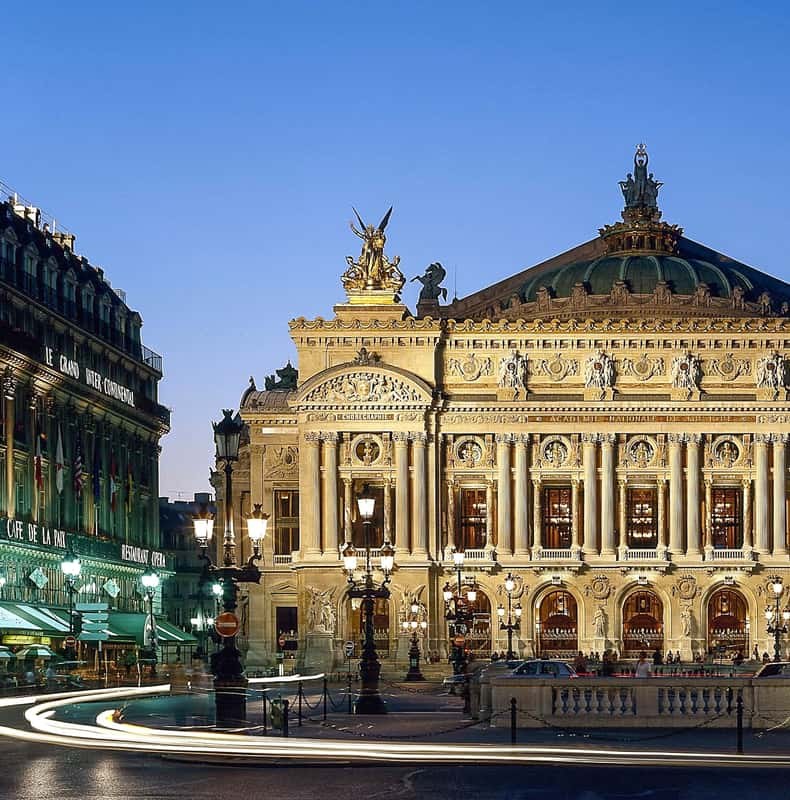
At the corner of Rue Scribe and Rue Auber, not on the front steps. That mistake costs between five and twenty minutes depending on how long you stand looking up at Place de l'Opéra, 75009 Paris before somebody tells you. Guided departures meet on one of four street corners within two minutes of the door; the map page has all of them.
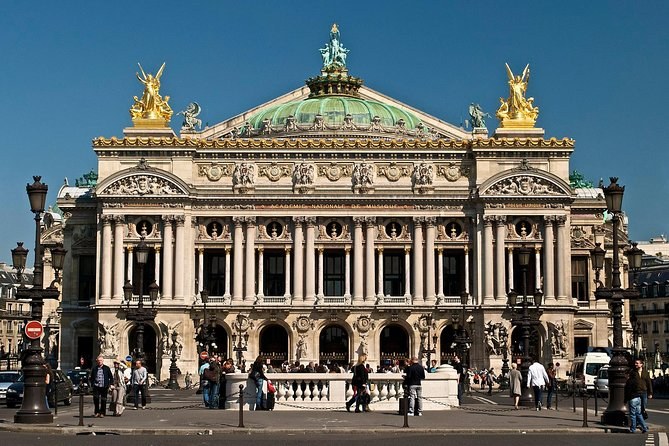
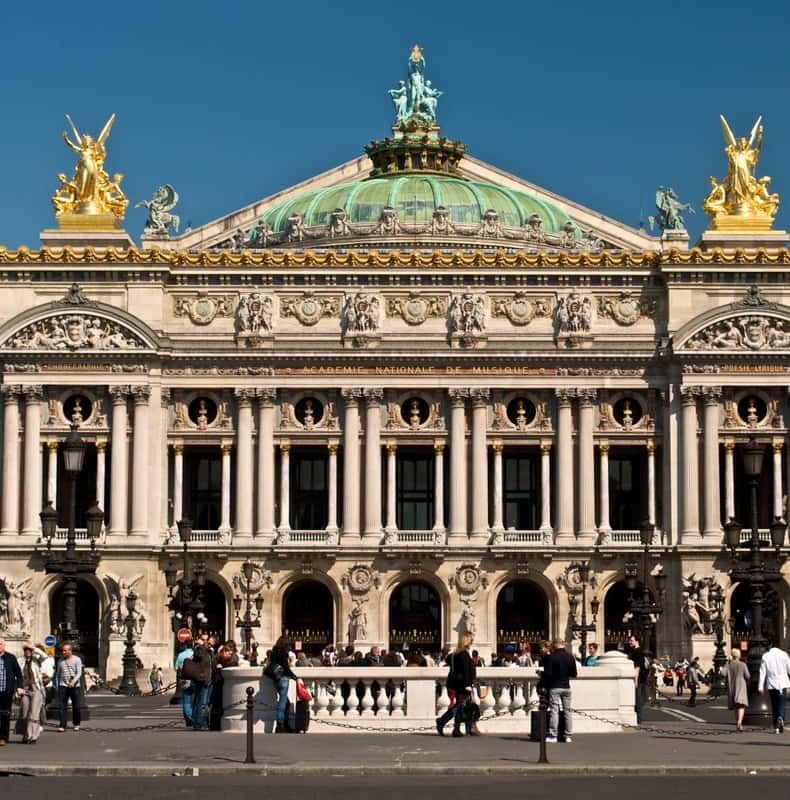
Give the facade five minutes from across the square before you go round, because you will not see it again for an hour and a half.
Minutes 0 to 6: the bottom of the building
You come in under the Rotonde des Abonnés, which is the only room here designed to feel like a basement. Dark marble, low ceiling, and the place carriages pulled in so that subscribers never met the weather. Four minutes.
Two more for the Pythia: a bronze oracle wound about with snakes, above her basin at the foot of the ramp. Almost everybody walks past her towards the light, which is exactly the effect the architect wanted and a reason to stop.
Minutes 6 to 26: the Grand Staircase
Twenty minutes, and you will want more. White marble, a red and green marble balustrade, and a well of open air 30 metres high overhead. The stair splits into two curving flights and rejoins, which is an awkward way to reach a first floor and a perfect way to be watched doing it.
Do two things here. Stand at the bottom and look up. Then climb to the first landing, turn, and look back down: the lamps light faces rather than floors, and the whole arriving crowd is arranged in a shallow bowl beneath you. That is the room working as designed. The rooms page has the rest.
Minutes 26 to 31: the avant-foyer
Five minutes and you will want to move on, which is the intention. It is low and vaulted in gold mosaic, close enough overhead to read comfortably, and it exists to make the next room feel enormous. Look up once, properly, then go through.
Minutes 31 to 56: the Grand Foyer
Twenty-five minutes, the longest single stop, and the room most photographs are of. 54 metres long, 13 metres wide, 18 metres high, mirrors down one side and windows down the other so the light doubles.
Walk its whole length once looking up at Paul Baudry's ceiling panels, then walk back looking along it at eye level. They are two different rooms and most visitors only ever see the first. If you have a tablet, this is where it earns its €8 on site, €7 booked ahead.
Minutes 56 to 70: the salons and the Rotonde du Glacier
Eight minutes for the Sun and Moon salons, which sit at either end of the foyer and which most people miss entirely because the room pulls the eye straight through the middle. Turn left and right at the ends. One is gold and mosaic and reads as morning; the other is silver and mirror and reads as one in the morning.
Six for the Rotonde du Glacier, the ice-cream rotunda, hung with tapestries and painted with drinking and hunting. On a bright day it has the best light in the building.
Minutes 70 to 85: the Library-Museum
Fifteen minutes, included in the ticket, and quiet because it is a door off the route rather than a room on it. The Bibliothèque-Musée de l'Opéra holds close to 600,000 items and a rotating exhibition, in the pavilion built for an Emperor who never used it. The exhibitions page has what is showing.
What about the auditorium?
Where does the time actually go wrong?
In two places, both predictable. The first is the bottom of the staircase, where everybody stops, photographs upward and stands. It is the worst view of the best room in the building: the stair is designed to be seen from the first landing, looking back. Five minutes at the bottom is plenty, and fifteen at the top is not too many.
The second is the Grand Foyer, where people walk in, stop about four metres from the door and take the same photograph everybody takes. The room is fifty-four metres long and almost nobody walks its full length. Do that first, then come back and photograph whatever you want.
How does the timing change with a guide?
The sequence does not, because the building will not let it. What moves is the distribution: a guide spends longer on the staircase and in the foyer, where there is something to say, and considerably less in the Library-Museum, which is a reading room rather than a set piece.
A ninety-minute guided departure therefore covers roughly the same ground as this plan with about fifteen minutes redistributed towards the two big rooms. A two-hour one adds depth rather than doors — with one exception, which spends its second hour outside the building entirely.
What do you cut if you have an hour?
- Cut the Library-Museum first, at fifteen minutes. It is the easiest whole block to lose.
- Cut the salons, at eight. Most visitors miss them by accident anyway.
- Do not cut the bottom four minutes. The rotunda and the Pythia set up the sequence, and arriving straight into the staircase removes the point of it.
- Do not cut the staircase. Twenty minutes is the floor, not the target.
What do you add if you have two hours?
Two things, and neither is a room. The first is the current exhibition, which sits in the public areas and comes with the ticket rather than as a second purchase. The second is time: walk the Grand Foyer a third time when it has emptied slightly, and sit down in the Rotonde du Glacier, which nobody does.
If you would rather spend the second hour outside, one departure walks north-east along Boulevard Haussmann and finishes on the Galeries Lafayette roof terrace instead. That is a different day and a good one.
Does the exhibition change the plan?
By ten or fifteen minutes, and it sits inside the route rather than beside it. Whatever is showing in the public areas comes with the admission you already hold, so it is not a decision so much as a thing you walk into somewhere between the foyer and the salons.
The one thing it changes is crowding, and a free exhibition in the public rooms brings in people who would not otherwise have bought a ticket. Between late October and February, being through the door at ten matters more than usual. The exhibitions page has the dates.
What should you do with the last ten minutes?
Go back to the staircase. It is the room you saw first, when you had no idea what the building was doing, and it is completely different once you have walked the foyer and understood what the arrival was for. Nobody does this and it is the best ten minutes available.
If you would rather leave, the door puts you back on Rue Scribe two minutes from three métro lines, and the Galeries Lafayette roof terrace is a few minutes north-east and free. The map page has the walk.
Frequently asked questions
Can I do it in forty-five minutes?
Is there a fixed route?
When is it quietest?
Where do I sit down?
Does a guided tour follow this order?
Paris Opera House Tours lists every departure with the time it actually spends inside, and the room-by-room post covers what is in each space rather than how long it takes.