You have decided you want a guide. That is a different question from whether to want one, and it deserves a different page. This one is about what the money does once it has changed hands, and how the six guided departures differ from each other.
What does the fare actually cover?
| What you are buying | Is it real? | Detail |
|---|---|---|
| The entrance ticket | On all but one | One fare covers guiding only and leaves the admission to you |
| A start time you choose | Yes | Two operators offer a morning or an afternoon; the ticket gives you a released slot |
| Your party only | Yes, on all six | Caps run from five to fifteen, and nobody is added to fill a departure |
| Commentary | Yes | The thing almost every five-star review names |
| A route that adapts | Yes | The practical value in a building where a room shuts without notice |
| A queue-jump | No | The building does not operate one, and one listing says so outright |
| The auditorium | No | Nobody can promise it, at any price |
Book a Paris Opera House guided tour
What can a guide do that a tablet cannot?
Notice things. The Opera's multimedia handset at €8 on site, €7 booked ahead is genuinely good and it runs the same script whatever is happening in the building. A guide arrives knowing whether a box door is open today, whether the exhibition has changed, and which room the crowd is currently in.
Travellers describe this without naming it: going at their own pace, seeing what interested them rather than a fixed list, never being rushed. That is a person rebuilding ninety minutes in real time, and it is the part of the fare that has no substitute.
How do the six departures differ?
Less than the price range suggests, and more than the titles do. Three are quoted per group and three per person, which is the difference that actually moves the sum. Two run ninety minutes and four run two hours. One excludes the entrance ticket. One ends somewhere else entirely.
The private tours page sets the six out in one grid with their caps, their languages and their refund windows.
Does the guide's language matter?
More than people expect. Between them the operators here guide in French, Italian, Spanish, German, Portuguese and Romanian as well as English, but no single operator offers all of those and the booking forms do not always match the marketing copy.
Two travellers here note that their guide's English was a struggle in places while still rating the visit highly. Check the language on the listing you are about to book rather than assuming.
Why do the reviews name people rather than rooms?
Because at this building the guide is the product. The rooms are fixed, the route is fixed and the admission is the same €25 whoever sells it to you. What varies between a good ninety minutes here and a mediocre one is entirely the person.
That is why almost every five-star review names a guide, and why the mediocre reviews also name a person — one describes a guide who was warm and eager and could do with more time in the building before guiding it. When you book here you are booking an individual more than a product.
What does a private party actually change?
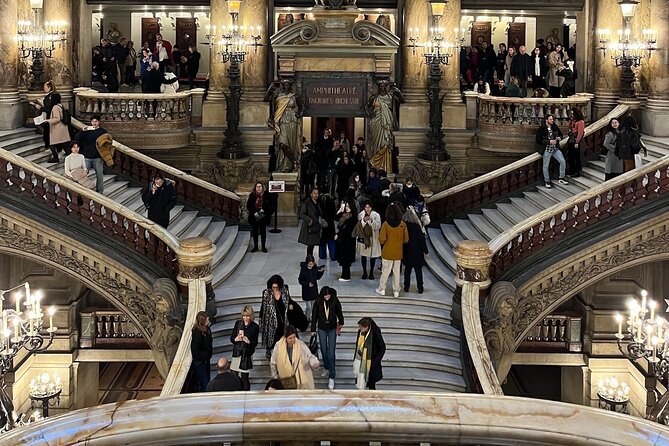
Two things, and one of them is acoustic. The rooms echo, they fill after mid-morning, and one reviewer on a private departure writes that the crowds made it hard to hear her own guide. A party of two hears everything; a party of five hears most of it.
The other is the questions. A private ninety minutes is a conversation rather than a broadcast, and the reviews that describe the best visits here all describe questions being answered rather than a script being delivered.
Is a longer tour better value?
Not automatically. Two hours in this building is not twice as many rooms as ninety minutes — it is the same eight rooms with more said about each. The one exception is the departure that spends its second hour outside on Haussmann's boulevards and finishes on a roof terrace, which is genuinely a different product.
With children, ninety minutes is the better buy. One operator's own reviewer, with a ten- and a twelve-year-old, says two hours was a stretch and recommends the shorter version.
How much does the group cap actually matter?
It is the difference between a conversation and a tour. The caps here run from five to fifteen and both ends are described as private, which is technically true and practically two different products. A party of five in the Grand Foyer can all hear the same sentence; a party of fifteen cannot, in a room with that much marble in it.
If you are booking as two people, the cap tells you the maximum size of the group you might end up sharing your guide with — except that on every one of these listings only your own party takes part, so the cap is really telling you how large a party the operator will accept, not how large yours will be. That matters if you are eight people and rules out four of the six.
What does the meeting point tell you about the operator?
More than you would think. Five operators use four different streets, and the ones who write a real instruction — naming a cafe, describing which side of a door — are the ones whose reviews mention a guide who was easy to find. One traveller singles out a guide who texted the evening before to say exactly where to stand and calls it the thing that removed the confusion.
The reverse also shows up. A one-star review here describes an hour spent walking around the building looking for a guide who never appeared, and a call that went to an answering machine. The map page puts all five meeting points on the ground.
What a guide cannot fix
What does two hours buy that ninety minutes does not?
Depth, and on one departure, a second building. The eight rooms are the eight rooms; nobody is unlocking a ninth. What the extra half-hour buys is time spent on the things a ninety-minute guide has to summarise — the competition, the water under the site, what the panels overhead are of.
The exception is the departure that spends an hour and forty minutes inside and then walks north-east along Haussmann's boulevards to finish on a roof terrace. That is not a longer version of the same tour; it is a different afternoon, and it is the only one in the captured set that goes anywhere else.
Does the refund window tell you anything about the operator?
Not about quality, and quite a lot about risk. Most of these fares refund nothing at any notice, which is unusually harsh and worth knowing before you pay rather than after. Two give a full refund at twenty-four hours, and those two are not the cheapest or the best-rated — the policy runs independently of everything else.
If your dates are firm, the window costs you nothing. If they are not, it is the first thing to sort on, and every card states its own before you click.
Who should still not book one?
- Solo travellers on a per-group fare. Paying five people's price for one person is a poor use of $591.
- Anyone with under an hour. Leaving a guided departure halfway through is worse than the ticket alone.
- Anyone whose plans might change. Most of these fares refund nothing at any notice.
Frequently asked questions
Do all the guided tours include the entrance?
How far ahead should I book?
Can I request a language?
What happens if I am late?
Is a guide worth it if I have already read about the building?
Paris Opera House Tours sets the guided fares side by side, and the decision guide covers the question this one assumes you have already settled.